
Introduction
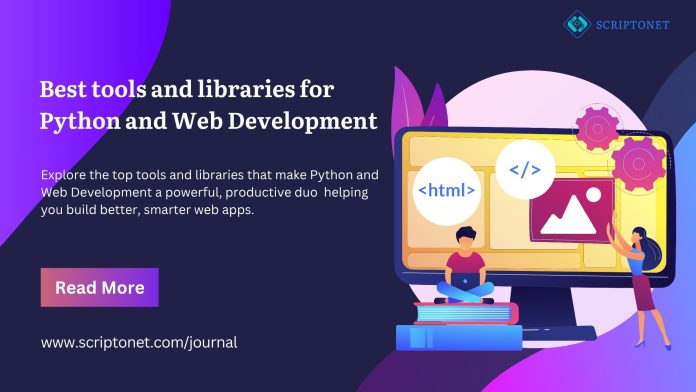
In today’s digital world, Web Development skills are more in demand than ever. Python and Web Development have become a powerful combo, giving developers the ability to build dynamic & interactive websites with ease. In this article, we’ll explore some of the best tools & libraries that make working with Python and Web Development even more efficient. We’ll also touch on the history, practical uses & different perspectives to give you a complete picture.
The rise of Python in Web Development
Python has exploded in popularity among web developers & for good reason. Its clean, readable syntax makes it easy for beginners to pick up, while still offering plenty of power for experienced developers. Python was created by Guido van Rossum back in the late ’80s & over time, it’s evolved into a go-to language used across many industries, including Web Development.
Why choose Python for Web Development?
One of the biggest reasons developers love Python is because of its vast library support. Frameworks like Django & Flask simplify Web Development so much. Django is packed with built-in features such as user authentication, database handling & admin dashboards, all ready to use out of the box. Flask is more minimalistic, giving you flexibility to build what you want without extra bloat.
Comparison with other languages
Compared to languages like JavaScript or Ruby, Python stands out for how easy it is to learn & use. JavaScript is essential on the front end, no doubt, but Python shines on the back end. That’s why Python and Web Development go so well together. Use JavaScript for your front-end magic & Python to handle your server-side logic.
Essential tools for Python and Web Development
Integrated Development Environments (IDEs)
Using the right IDE can make a huge difference in your productivity. Here are two of the best for Python and Web Development:
- PyCharm: A feature-rich IDE with intelligent code completion, powerful debugging & built-in support for version control tools like Git.
- Visual Studio Code: Lightweight, fast & super customizable. It supports Python beautifully & has tons of extensions for Web Development.
Version Control Systems
Version control is a must when working on any serious project. Git is the go-to tool here. It lets you track changes, roll back if something breaks & collaborate with others easily. Services like GitHub & GitLab make it simple to host, manage & share your code.
Frameworks for Web Development
Frameworks help take care of the heavy lifting so you can focus on building your app. Here are two standout options:
- Django: Great for big, complex web apps. It comes with everything you need — just add your custom logic & go.
- Flask: Perfect for smaller projects or when you want full control over the structure. It’s lightweight but still powerful.
Libraries that enhance Python and Web Development
Front-end libraries
Even though Python is mostly used on the back end, you can still build awesome user interfaces by pairing it with front-end libraries like React & Vue.js. These tools help you build smooth, interactive web experiences & they play nicely with Python back ends.
Data handling libraries
If your app deals with a lot of data, you’ll want tools to manage it efficiently. Pandas & NumPy are essential — Pandas makes working with datasets easy & NumPy is great for numerical computing.
API development libraries
APIs let different parts of your app (or other apps) talk to each other. Flask-RESTful & Django REST Framework are fantastic options for building RESTful APIs quickly & cleanly.
Counter-arguments & limitations
Of course, Python isn’t perfect. One common criticism is its performance, because it’s an interpreted language, it can run slower than compiled languages like C++. But honestly, for most web apps, the speed difference is barely noticeable.
Another point to consider is hosting. While platforms like Heroku, AWS & DigitalOcean support Python, some hosting providers still favour PHP or JavaScript-based stacks. This can limit your options slightly, but it’s getting better all the time.
Conclusion
To wrap it up, Python and Web Development make a killer combo. With a strong ecosystem of tools & libraries, developers can build web apps that are powerful, scalable & user-friendly. Yes, there are a few drawbacks, but the benefits far outweigh them, especially if you’re looking for speed, simplicity & flexibility.
Key Takeaways
- Python is a flexible, beginner-friendly language that’s great for Web Development.
- Frameworks like Django & Flask help you build faster & smarter.
- Libraries for data handling & API building extend your app’s functionality.
- While not the fastest language, Python’s performance is more than good enough for most web projects.
Frequently Asked Questions (FAQ)
Which web development and Python frameworks are the best?
The top choices are Django for larger, feature-rich projects & Flask for smaller, more flexible apps.
What is the difference between Python and JavaScript for web development?
Front-end programming is dominated by JavaScript, but back-end programming is best suited for Python. They form a complete web development stack when integrated.
Can I use Python for front-end development?
Not directly. Python is for the back end, but it can work with front-end tools like React or Vue.js to create seamless full-stack apps.
Which Python data handling libraries are widely used?
NumPy (for numerical analysis) and Pandas (for processing structured data) are essential tools for projects involving a lot of data.
Is Python suitable for large-scale web applications?
Absolutely. Frameworks like Django offer the scalability, security & structure needed for large apps.